


10 Problems Every Visa Agency Faces and How Technology Solves Them
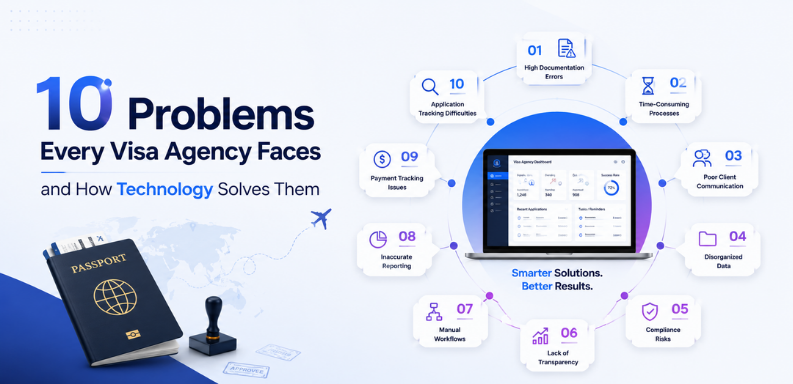
Discover the 10 biggest challenges visa agencies face, from manual data entry to lost leads and how AI-powered visa automation software solves each one.
Running a visa agency today means juggling paperwork, client follow-ups, embassy timelines, and staff bandwidth all at once. Most agencies lose time and revenue not because of bad service, but because manual processes cannot keep up with rising application volume. This article breaks down the ten most common operational problems visa agencies face and explains how visa automation software solves each one.
1. Manual Data Entry Slows Down Every Application
Typing passport details, dates, and personal information by hand is slow and error-prone. A single mistyped passport number can delay an entire application. This is one of the biggest hidden costs in a visa business, because staff hours go into repetitive typing instead of client service.
How technology solves it: An AI passport scanner uses passport OCR software to read and extract data directly from a passport photo page in seconds. Fields like name, nationality, date of birth, and passport number are auto-filled into the application form, cutting manual entry time dramatically and reducing typos that lead to rejections.
2. Losing Track of Leads and Follow-Ups
When inquiries come in through phone calls, WhatsApp, email, and walk-ins, agencies often lose leads simply because no one followed up in time. Spreadsheets and sticky notes cannot scale once inquiry volume grows.
How technology solves it: A dedicated visa CRM software captures every lead in one place, assigns it to a team member, and triggers automated reminders. With visa lead management software, no inquiry sits untouched, and conversion rates improve because follow-ups happen on schedule instead of by memory.
3. Disorganized Document Collection
Collecting bank statements, photographs, invitation letters, and identity documents from clients through scattered email threads creates confusion. Missing documents are one of the top reasons visa applications get delayed.
How technology solves it: Visa document management tools inside a modern visa processing platform give each client a secure upload portal with a checklist specific to their visa type. Agencies can see exactly what is pending at a glance instead of chasing documents manually.
4. No Real Visibility Into Application Status
When applications are tracked in separate files or notebooks, it becomes difficult to know how many cases are in progress, stuck, or ready for submission. This lack of visibility makes it hard to plan staff workload.
How technology solves it: A visa application tracking software gives agencies a live dashboard showing every case by stage, so managers can identify bottlenecks early and reassign work before deadlines are missed.
5. Repetitive Client Communication Eating Up Staff Time
Answering the same status update questions over and over, day after day, pulls staff away from higher-value work like consultations and case reviews.
How technology solves it: With visa follow-up automation, clients receive automatic WhatsApp, SMS, or email updates whenever their application moves to a new stage. This reduces inbound status queries and frees staff to focus on complex cases.
6. Uncertainty Around Visa Eligibility
Staff, especially newer team members, often struggle to confirm whether a client qualifies for a particular visa category before starting the process, which can waste time on applications that were never eligible in the first place.
How technology solves it: A built-in visa eligibility checker screens client details against destination-country criteria early in the process, helping teams set correct expectations with clients from the very first conversation.
7. No Branded, Professional Online Presence
Many visa agencies still rely on generic contact forms or third-party marketplaces, which means they don't own the client relationship or the brand experience.
How technology solves it: A white label visa website gives an agency a fully branded, professional online storefront where clients can browse visa services, submit applications, and track progress under the agency's own name, not a third-party platform.
8. Difficulty Scaling to Multiple Locations or Countries
As agencies grow into new cities or add new visa corridors, keeping every branch consistent in process and quality becomes a serious challenge with manual systems.
How technology solves it: A cloud-based visa processing system standardizes workflows across every branch, so new locations can be onboarded quickly using the same automated processes, document checklists, and CRM structure that already work.
9. Errors From Repeating the Same Manual Steps
Every manual step — data entry, form filling, status updates, document checks — is a chance for human error. Even experienced staff make mistakes when handling high volumes of near-identical tasks.
How technology solves it: Visa workflow automation removes repetitive manual steps by auto-generating forms, auto-updating statuses, and running consistency checks, so the same rules apply to every application without relying on memory.
10. Limited Insight Into Business Performance
Without centralized data, it's difficult for agency owners to know which visa types are most profitable, which staff members close the most cases, or where delays are actually happening.
How technology solves it: A unified visa business software platform brings reporting and analytics into one dashboard, giving owners clear visibility into performance, turnaround times, and revenue by service or location.
Why Visa Agencies Are Moving to Automation
Across each of these ten problems, the pattern is the same: manual, disconnected processes create delays, errors, and lost revenue. Automated visa processing connects lead capture, document collection, application tracking, and client communication into a single system. Agencies that adopt this kind of visa automation platform typically process more applications with the same team size, respond to clients faster, and reduce the errors that lead to rejected or delayed applications.
Ready to Modernise Your Visa Agency?
Every problem covered in this article shares a common fix: replacing manual, scattered processes with one connected system built specifically for visa businesses. Visakix brings AI passport scanning, visa eligibility checks, a white-label client portal, CRM, and workflow automation together in a single visa processing platform designed for agencies, travel agents, and visa consultants.
Start Your Free Trial or Book a Demo to see how Visakix can help your agency process more applications with less manual work.
Frequently Asked Questions
What is visa automation software?
Visa automation software is a digital platform that handles the operational side of running a visa agency, including lead capture, document collection, application tracking, client communication, and reporting, in one connected system instead of separate manual tools.
How does an AI passport scanner help visa agencies?
An AI passport scanner reads a passport's photo page and automatically extracts details like name, passport number, and date of birth, removing the need for manual typing and reducing data-entry errors that can delay an application.
Can a small visa agency use white-label visa software?
Yes. White-label visa software is built to scale from a single-person agency to a multi-branch business, giving smaller agencies a branded, professional client experience without the cost of building custom technology in-house.
Does visa automation software guarantee visa approval?
No software can guarantee visa approval, since approval decisions are made solely by the relevant embassy or government authority. Automation software improves accuracy, organization, and speed on the agency's side of the process.
How long does it take to set up a visa processing platform?
Setup time varies by agency size and the number of visa services offered. Most agencies can onboard core workflows such as lead capture, document checklists, and application tracking within a short setup period, with additional customization added over time.